
SpeciesSplit Mixed-Species Matrix Partitioning
SpeciesSplit performs species-level partitioning on single-cell expression matrices from multiplexed multi-species experiments, separating the pooled matrix into species-specific sub-matrices for downstream analysis of each species independently.
Applicable Scenarios
When cells from multiple species are pooled and loaded into the same GEM, alignment is performed against a combined reference genome. After standard analysis, gene identifiers in the resulting expression matrix carry species-specific prefixes (e.g., GRCh38-GAPDH, Sus_scrofa-ALB). SpeciesSplit leverages this feature to automatically detect species prefixes, assign each cell to its species of origin, and partition the data into independent Seurat objects.
Partitioning Principle
Cell Species Assignment
Cell species identity is determined based on the user-selected method:
| Method | Assignment Logic | Required Parameters |
|---|---|---|
| seekone | Compute the UMI proportion of species-prefixed genes per cell (denominator includes only UMIs from species-prefixed genes); assign the cell to a species if its proportion > Threshold; otherwise label as Multiplet | Threshold |
| cellranger | Read the call column from the CellRanger gem_classification.csv file to directly assign species identity | gemClassification file path |
Handling of Unprefixed Genes
Viral genes (e.g., HBx, SV40) or engineered genes (e.g., CAR, fluorescent proteins) incorporated into the combined reference genome may lack a species prefix. During partitioning, such genes cannot be assigned to any single species. The module treats unprefixed genes as shared genes, retaining them in every species-specific sub-matrix so that their expression can be examined across all species downstream.
To restrict an unprefixed gene to a specific species only, it must be placed under that species namespace during reference genome construction (e.g., GRCh38_EGFP will be retained exclusively in the human sub-matrix and will not appear in other species' sub-matrices).
Cloud Platform Parameters
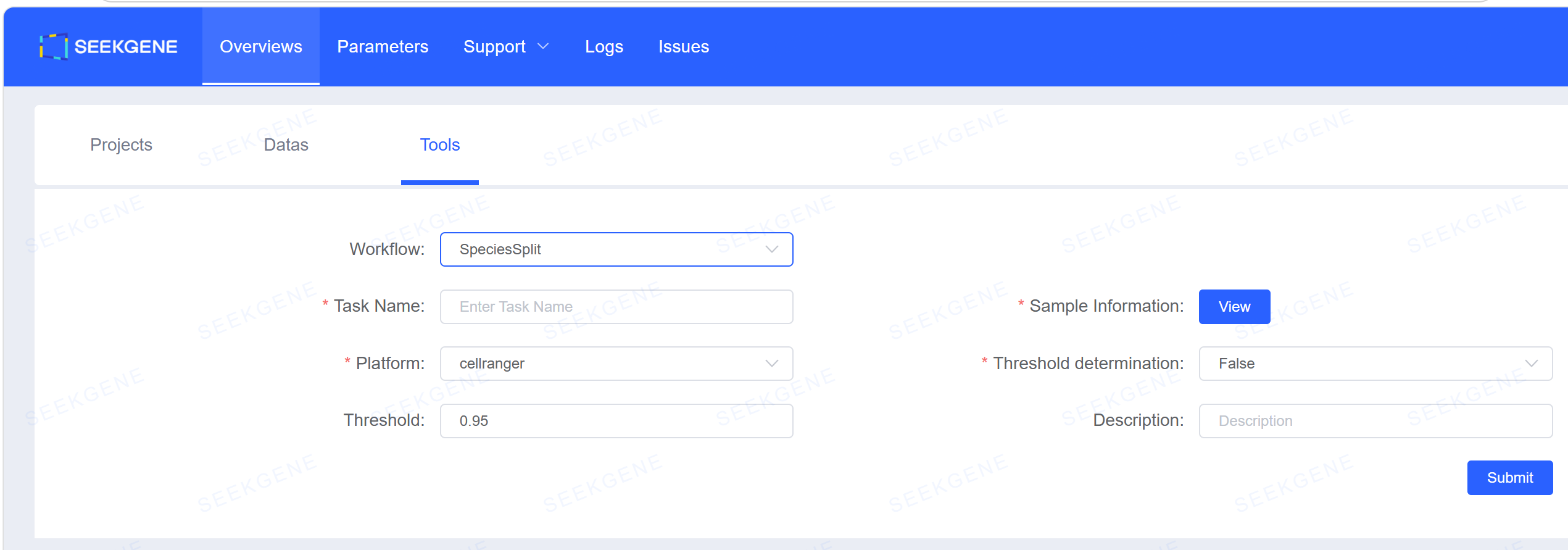
| Parameter | Description |
|---|---|
| Analysis Pipeline | SpeciesSplit |
| Task Name | Task name; must not duplicate any existing task name |
| Sample Info | Enter sample names; analysis batch and file OSS paths are auto-populated. Verify the correct analysis batch |
| Platform | Species assignment method, either seekone or cellranger |
| Threshold | UMI proportion threshold, range 0–1, default 0.95. Only applicable to the seekone method |
| Description | Task description, optional |
Notes
WARNING
Gene identifiers must contain a species prefix (e.g., GRCh38-GAPDH, mm10-Gapdh); otherwise the module cannot resolve species identity, and all cells will be labeled as unknown with partitioning skipped.
- Only transcriptomic data types are supported; multi-omics data types are not yet supported.
- A single sample name may correspond to multiple analysis batches. The last batch is populated by default; verify and select the intended batch.
- Genomes field accuracy: It is recommended to use
cellranger mkref --genometo specify a separate genome name for each species during reference genome construction. - Unprefixed exogenous genes: Viral genes (HBx, SV40) or engineered genes (CAR, fluorescent proteins) without a species prefix are retained as shared genes in every species-specific sub-matrix after partitioning; if a species prefix is present (e.g.,
GRCh38_EGFP), the gene appears only in the corresponding species' sub-matrix. - Species prefix limit: The module supports a maximum of 10 species prefixes; exceeding this limit will trigger an error and terminate execution (typically indicating incorrect gene naming conventions).
Supported Species Prefixes
The built-in species_mapping.json mapping file covers the following species:
| Species | Prefix Examples | English Name | Latin Name |
|---|---|---|---|
| Human | GRCh38, Homo_sapiens, human | human | Homo sapiens |
| Mouse | GRCm39, Mus_musculus, mm10, mouse | mouse | Mus musculus |
| Pig | Sus_scrofa, Sus, pig | pig | Sus scrofa |
| Rhesus macaque | Mmul_10, Mmul, Macaca_mulatta, Rhesus_monkey | Rhesus monkey | Macaca mulatta |
| Fruit fly | Drosophila_melanogaster, fruit_fly | fruit fly | Drosophila melanogaster |
| Zebrafish | Danio_rerio, zebrafish | zebrafish | Danio rerio |
| Chicken | Gallus_gallus, chicken | chicken | Gallus gallus |
| Cattle | Bos_taurus, Bos, cattle | cattle | Bos taurus |
| Dog | Canis_lupus_familiaris, Canis_familiaris, dog | dog | Canis lupus familiaris |
| African clawed frog | Xenopus_laevis, african_clawed_frog | african clawed frog | Xenopus laevis |
| Nematode | Caenorhabditis_elegans, nematode | nematode | Caenorhabditis elegans |
| Budding yeast | Saccharomyces_cerevisiae, budding_yeast | budding yeast | Saccharomyces cerevisiae |
| Goldfish | gold_fish, goldfish | gold fish | Carassius auratus |
| Red crucian carp | CAred, Red_crucian_carp | Red crucian carp | Carassius auratus red var |
| Rabbit | Rattus_add_EGFP, Rattus, rabbit | rabbit | Oryctolagus cuniculus |
If the reference genome prefix used in your experiment is not present in the mapping file, the module will automatically fall back to regex-based prefix detection.
Comparison of Assignment Methods
| Aspect | seekone | cellranger |
|---|---|---|
| Assignment basis | UMI proportion of species-prefixed genes | CellRanger classification output file |
| Required parameter | Threshold (proportion threshold) | gemClassification file |
| Multiplet detection | Cells below threshold are automatically labeled | Dependent on CellRanger output |
| Compatible platform | SeekSoul Tools / SeekArc Tools | 10x Chromium |
Both methods share identical species detection and partitioning logic; they differ only in how cell species identity is determined.